In this guide
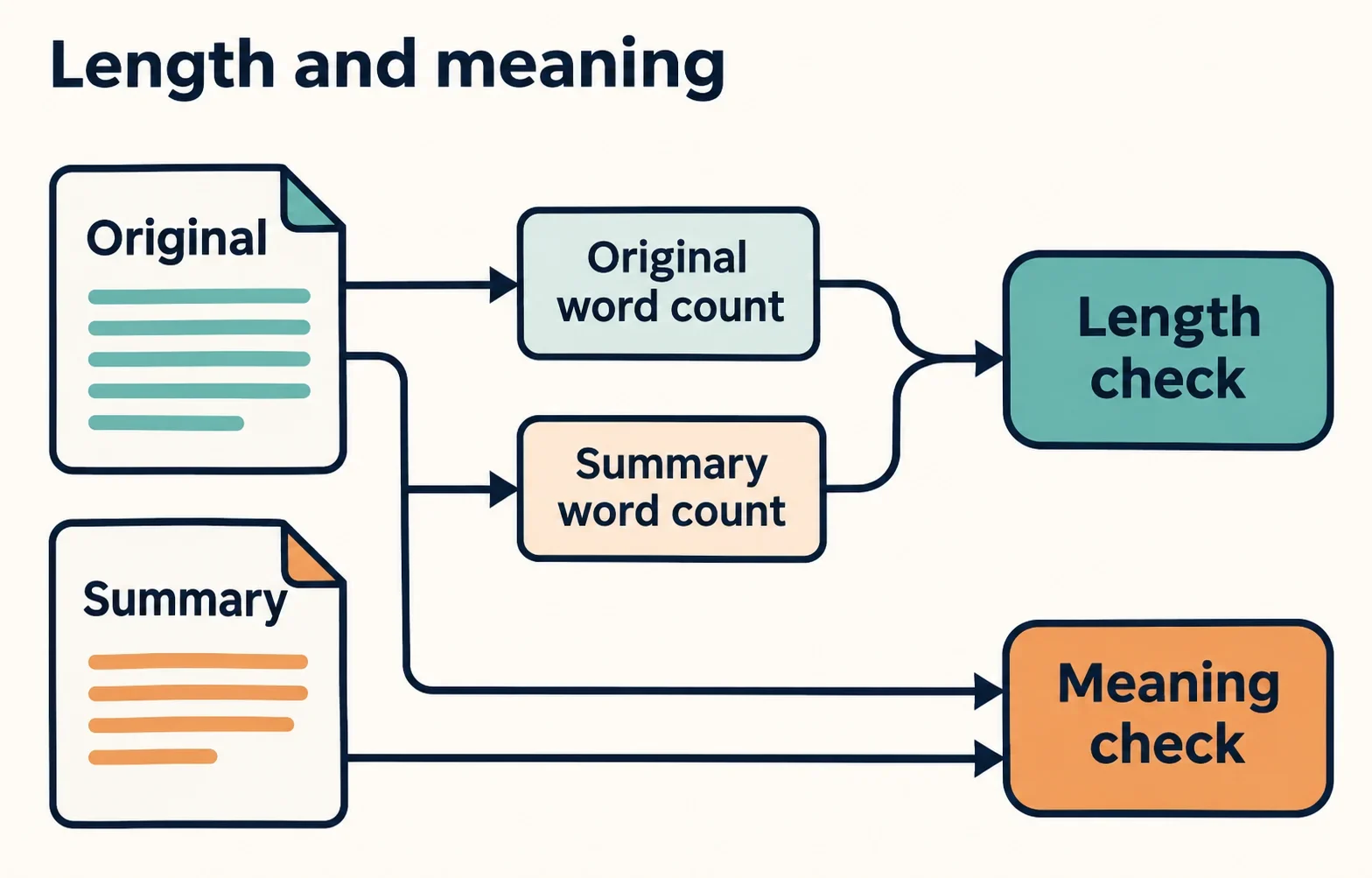
Count the original passage and its summary separately with the same counter and counting convention. Record the totals as O and S, subtract S from O to find words removed, and divide that difference by O and multiply by 100 to calculate the percentage reduction when O is greater than zero.
Those measurements answer how much shorter the summary is and whether it meets a length requirement. A separate comparison with the preserved original checks whether the main claim, necessary support, and qualifications remain. Use the following workflow to make both decisions without losing either version.
Decide which text belongs in each count
Start by identifying the exact passage being summarized and the summary written from it. If you summarized one excerpt from a longer document, select that excerpt as the original. Counting the entire document would answer a different question from comparing the excerpt with its summary.
Before copying either version, check what the applicable length requirement covers. Ask:
- Are titles and headings included?
- Do citations belong in the total?
- Should quotations within the passage be counted?
- Does the requirement cover only the main text or additional material?
If the requirement answers these questions, follow it. If it does not, choose a clear working rule and record it beside your counts. For example: “Main text only; titles excluded; quotations within the selected passage included.” This is a counting choice for your comparison, not a rule every destination follows.
Apply the chosen convention to both versions wherever the corresponding material appears. You do not need to add a title to a summary that has none. You do need to avoid silently including an original’s heading while excluding a comparable summary heading. Keep unrelated notes and instructions outside both selections unless the requirement includes them.
Count the original and summary separately
Keep the original passage and the current summary in separate, clearly labeled copies before using the counter. Treat the counter’s input area as a place to measure text; preserve your versions elsewhere so replacing the input does not remove your only copy.
- Paste the selected original into the counter.
- Read the word total and record it as O.
- Replace the input with the corresponding summary.
- Use the same counter and any relevant settings, then record the summary total as S.
Maintain a separate record such as this illustrative example:
| Text version | Label | Word count |
|---|---|---|
| Original passage | O | 400 |
| Summary | S | 100 |
Keep a short scope note below the table, such as “main text only.” Add a version label if you are comparing several drafts, so each summary total stays connected to the text that produced it.
Do not rely on remembering the first number while editing the second version. Record O before replacing the original in the input area and record S before making further changes. If you revise either selected text, update its total. If you change the counting convention, recount both versions so the comparison continues to use the same basis.
Calculate words removed and percentage reduction
Use the two recorded totals to calculate the size of the change. Keep the labels attached to the numbers so you do not accidentally subtract the original from the summary.
Words removed = O − S
With an illustrative original of 400 words and a summary of 100 words, the calculation is 400 − 100 = 300 words removed.
To express that change relative to the original, calculate:
Percentage reduction = ((O − S) / O) × 100, provided O > 0.
The same example gives (300 / 400) × 100 = 75%. The summary is therefore 300 words shorter, representing a 75% reduction from the original.
Interpret unusual results
- S equals O: zero words removed and 0% reduction. The versions have equal measured length, although their wording may differ.
- S exceeds O: both results are negative. For example, O = 400 and S = 440 gives −40 words removed and −10% reduction, indicating expansion.
- O equals zero: the percentage reduction is undefined because the calculation would divide by zero. Check that the intended original was actually selected before continuing.
A positive reduction describes a shorter measured text. It does not establish that the summary retains the original’s meaning; reserve that judgment for the content review.
Check the result against the summary-length target
First identify the kind of target you have. A maximum word count and a minimum percentage reduction are different requirements; if both apply, check both.
For a maximum of M words, the summary passes the length check when S ≤ M. A 100-word summary meets a maximum of 100 words; a 101-word summary does not.
For a required minimum reduction of r%, check whether ((O − S) / O) × 100 ≥ r, with O greater than zero. At O = 400, a reduction of at least 75% requires S to be no more than 100.
Reduction and remaining length
Percentage remaining uses a different formula: (S / O) × 100, again with O greater than zero. For the 400-to-100 example, 25% remains and 75% has been removed.
| Instruction | Result for a 400-word original |
|---|---|
| Reduce by 75% | Keep 100 words |
| Keep 75% | Keep 300 words |
Check the exact wording of the instruction: “reduce by” and “keep” cannot be substituted for each other.
Use unrounded results when deciding compliance. With O = 401 and S = 301, removing 100 words gives a reduction of about 24.94%. Rounding that to 25% does not make it meet a minimum reduction of 25%. You can round the number for display after making the decision from the full calculation.
Resolve differences between word counters
If two counters disagree, first check that they received exactly the same text. Compare the beginning and end of the selection, and look for a heading, citation, or other material included in only one copy.
Next, check whether both counts used the same convention and any relevant settings available. Look through the passage for apostrophes, hyphens, numbers, and non-Latin text. These are useful places to investigate a disagreement; do not assume a particular counting rule without checking the counter’s guidance or comparing its results.
For example, isolate a short portion containing a disputed item and count that identical selection in each system. This can help you locate the difference without guessing which total should apply to the whole passage.
Which total should guide submission?
If a destination system controls acceptance, check the final summary there. Before treating another counter as interchangeable, compare a representative technical passage with the destination system as well.
Keep each original-summary comparison internally consistent. Avoid calculating a reduction from an original measured by one convention and a summary measured by another. If you switch conventions, measure both again. Record the destination’s final summary count separately when needed to check its limit.
Review meaning before accepting the shorter version
A summary can satisfy a numerical target and still need revision. A word total describes length without establishing clarity, so compare the current summary with the preserved original before accepting it.
Read for these separate questions:
- Main claim: Does the summary still communicate the original’s central point?
- Necessary evidence: Is the support needed to understand that point still present?
- Qualifications: Have important limits or conditions survived the cuts?
- Logical relationships: Can readers follow how the retained ideas connect?
- Pronoun references: Is it clear what words such as “it,” “they,” or “this” refer to after editing?
For example, if an original claim applies only under a stated condition, check that the shorter version retains that condition. A smaller word total does not justify turning a limited statement into an unrestricted one.
If the summary is too long, look for duplicated content before trimming necessary details from every sentence. Removing a repeated point can preserve more meaning than spreading cuts evenly through the passage. After deleting or combining sentences, review pronouns again, because the words they referred to may have changed or disappeared.
Recount after each meaningful revision and update S, words removed, and percentage reduction. Finish with two explicit decisions: whether the summary meets the applicable length target, and whether it preserves essential meaning. Accept the version only when both checks are satisfactory.