Contents
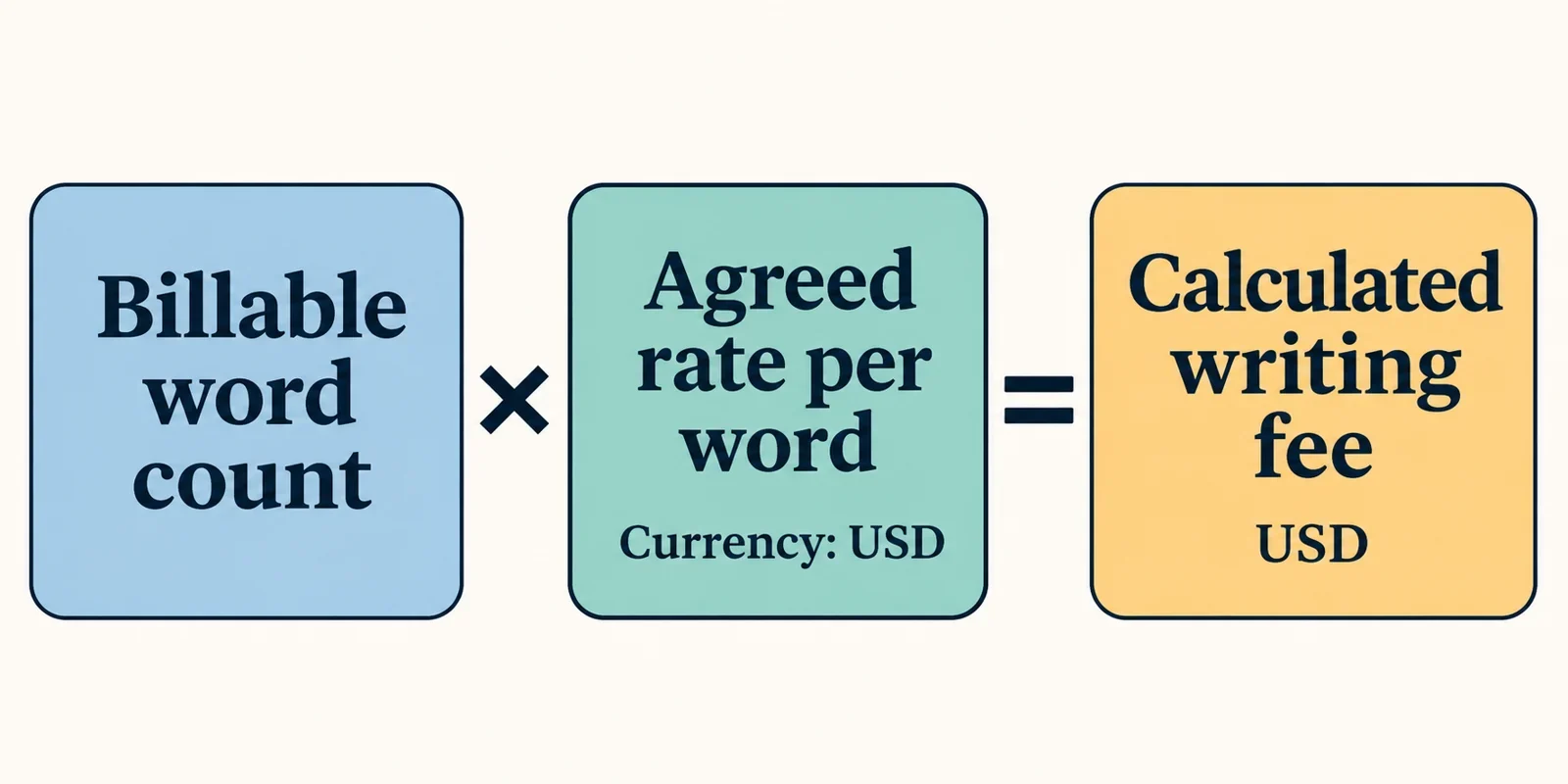
To calculate a freelance writing fee, count the text covered by your agreement and multiply that count by the agreed rate per word. Keep the rate’s currency attached to the result. The key decision comes before the multiplication: identify which version and which parts of the document the client has agreed to pay for.
A word counter helps establish the quantity used in that calculation. It does not decide whether a caption, quotation or revision is billable. Work through those decisions first, prepare a separate counting copy, and use a counting method both parties accept. Then keep the count and calculation together so you can explain the fee without reconstructing your process later.
Define which text is billable
Start with the billing agreement, brief or written confirmation of scope. Identify the deliverable it covers and whether payment depends on a submitted draft, an accepted version or the final delivered text. If that point is unclear, settle it before treating any count as final.
Which version and elements are included?
Name the version clearly enough that both parties can locate the same text. Then check each element against the agreed terms:
| Element | Decision to confirm |
|---|---|
| Body text | Which draft or delivered version applies? |
| Headings and captions | Are these included in the paid text? |
| Quotations | Does the agreement include quoted passages? |
| References and notes | Are these included, excluded or separately priced? |
Use this checklist to make explicit decisions about each element. If a quotation remains part of the paid deliverable, retain it in the count when the agreement requires that. If references are excluded, remove them only from the counting copy.
What if the agreement only says “per word”? Ask which version, text elements and counting method that phrase covers. A short written clarification gives you a basis for the calculation and helps prevent either party from relying on an unstated assumption.
Prepare the text for counting
Keep the original deliverable intact and create a separate copy for counting. This lets you apply billing exclusions without deleting useful material from the document the client receives. Identify the copy by its corresponding draft or delivered version so it cannot be confused with a later revision.
- Copy the version selected under the agreement.
- Retain the body text and any other included elements.
- Remove only the material explicitly excluded from billing.
- Check that included text has not been missed or repeated.
- Keep a note of the exclusions you applied.
Check the boundaries
Pay particular attention where excluded material sits beside included text. For example, if notes are excluded but captions are included, remove the notes while preserving the captions. Treat similar elements consistently throughout the document; do not exclude one reference list and retain another unless the agreement distinguishes them.
Before counting, compare the prepared copy with the selected version once more. Focus this check on billing scope. Keep any proposed wording corrections separate so the counting copy continues to match the selected deliverable, apart from the agreed exclusions.
Keep a separate copy before leaving the Word Counter page, and retain the prepared text with your billing notes.
Get and interpret the word count
Use the prepared billable text in the Word Counter, then record the count it returns. Keep that number tied to the exact copy you counted. A result taken from the complete document should not be substituted for the prepared copy’s result if the two contain different billable material.
Confirm what the number represents
The Word Counter counts runs of Unicode letters and numbers. Confirm that this counting method is the one your client accepts for billing. If a particular heading, notation or piece of text raises questions, agree how it should be handled rather than assuming that every counter treats it the same way.
For Chinese text, this method is not linguistic word segmentation. Before using the result to set a fee, confirm whether the client accepts this count or needs another agreed counting method. Do not present it as a linguistic Chinese word count.
What if the client’s count differs?
Compare the text being counted before debating the numbers. Check whether both parties used the same version and included the same headings, captions and other elements. Then compare the counting methods. Resolve the difference through an agreed method and record the resulting count; avoid switching methods simply to obtain a preferred fee.
If agreement is still pending, label your calculation as provisional and specify which counting decision needs confirmation.
Multiply the count by the agreed rate
Use two inputs: the agreed billable word count and the agreed rate per word. Check the rate against the agreement, including its currency, before calculating.
Calculated writing fee = billable word count × agreed rate per word.
For an illustrative count of 1,200 billable words, the calculation is 1,200 × your agreed rate. If that rate is expressed in a particular currency, the resulting fee is expressed in that currency too. Write the currency name or code beside the amount so the client does not have to infer it.
Perform the multiplication as a separate step with a calculator or spreadsheet. Record both inputs alongside the result, allowing you to check the arithmetic without having to recount the text. If you correct the count, update the calculation as well.
Check the unit before multiplying
Make sure the agreement actually specifies a rate per word. If the quoted rate applies to a different unit or to the entire assignment, resolve that difference before using this formula. A project price needs to be handled according to its own agreed terms.
Call the result the calculated writing fee. Any additional agreed adjustments belong in the next step so the relationship between count, rate and fee remains clear.
Resolve revisions and billing adjustments
Review the agreement before deciding what to do with additions, cuts or revised wording. The text that changed and the work required to change it are separate billing questions; use the agreed terms to decide how each affects payment.
Handle changes against the selected version
If the fee is based on the final delivered text, prepare the counting copy from that version. If the agreement identifies an earlier draft, keep that version available and follow the stated treatment of later changes. Combine counts from several drafts only when the agreement specifically calls for that approach.
For added passages, confirm whether they belong in the existing billable count or in separately agreed work. For removed material, check whether payment follows the counted version or another arrangement. A shorter final text alone does not settle what was agreed for earlier work.
Keep adjustments visible
Check for agreed rounding, minimum charges and separate fees. Record how any applicable term changes the amount after the basic multiplication. If no rule has been agreed, seek clarification before introducing one.
Show each adjustment separately from the calculated writing fee, with a brief explanation of the agreed basis. This makes it possible to review the word calculation independently of other charges.
Record the calculation
Keep the counted text and a compact calculation record together. The record should let you or the client reproduce the fee using the same version, scope and method.
| Record | What to keep |
|---|---|
| Counted version | Clear draft identifier and a copy of the counted text |
| Scope | Included elements, exclusions and any written clarification |
| Method | Word Counter’s counting method, or another method both parties accepted |
| Quantity | Recorded billable word count |
| Rate | Agreed amount per word and currency |
| Calculation | Count multiplied by rate, followed by any agreed adjustments |
Make the calculation easy to review
With your invoice or fee explanation, state the count, rate and currency, then distinguish the calculated writing fee from adjustments and the final amount. Include enough detail to identify the counted version without reproducing the entire assignment in the billing message.
Before sending, check that the saved text matches the recorded count, that the rate uses the agreed unit, and that exclusions match the terms. If the client questions the amount, begin with this shared record.
For the next assignment, confirm the same decisions before work begins. That gives both parties an agreed starting point for counting and payment.